
You catch more smallmouth in moving water when you treat eddies and current breaks like ambush maps. Start where fast current meets softer water behind rocks, bends, or logs, and cast slightly upstream across the seam so your bait drifts along the slower edge. Target depth changes, shallow shelves, and mid-column holds with spinnerbaits, crankbaits, and drop-shots matched to current strength. Mastering these subtle seams, structures, and depth shifts opens the door to consistently bigger river bass.
Reading Subtle Current Seams
How do you spot the invisible highways smallmouth use in moving water? Start where faster current meets slower water behind rocks, bends, or logs. Those subtle current seams form narrow feeding lanes that concentrate prey and bass without screaming “fish here.” You’re looking for tiny clues: a faint discoloration, a narrow sheen, or a thin, wavering line of churn showing a micro-eddy along that edge.
Predators often idle just upstream or on the downriver edge of these seams, slipping in and out to grab drifting food while saving energy. Cast slightly upstream across the seam, then retrieve with the flow, letting your bait drift and tick along the slower side. In clear water, stay focused on the leeward side where small eddies gather bait and cover. Additionally, understanding the importance of healthy sea-grass meadows can help you appreciate the overall ecosystem that supports these feeding patterns.
Detailed Features
Once you can read those subtle seams, you’re ready to break moving water into specific pieces that consistently hold fish. Start by finding where current peels away from rocks, islands, or bends. That separation line—where fast water shears past slack—creates an eddy on the downstream, sheltered side.
Predators use that soft pocket as an ambush zone while baitfish circle in the calm water. Face upstream, note the flow direction, then target the back side of points and the outside edges of the swirling eddy. In higher water, cast slightly upstream or cross-current so your offering drifts naturally along those edges. Hold your position and work every angle—one well-defined eddy tip can easily give up 10–20 smallmouths. Additionally, understanding rod action type can improve your casting technique and increase your chances of a successful catch in these dynamic conditions.
Tackle and Gear Specifications
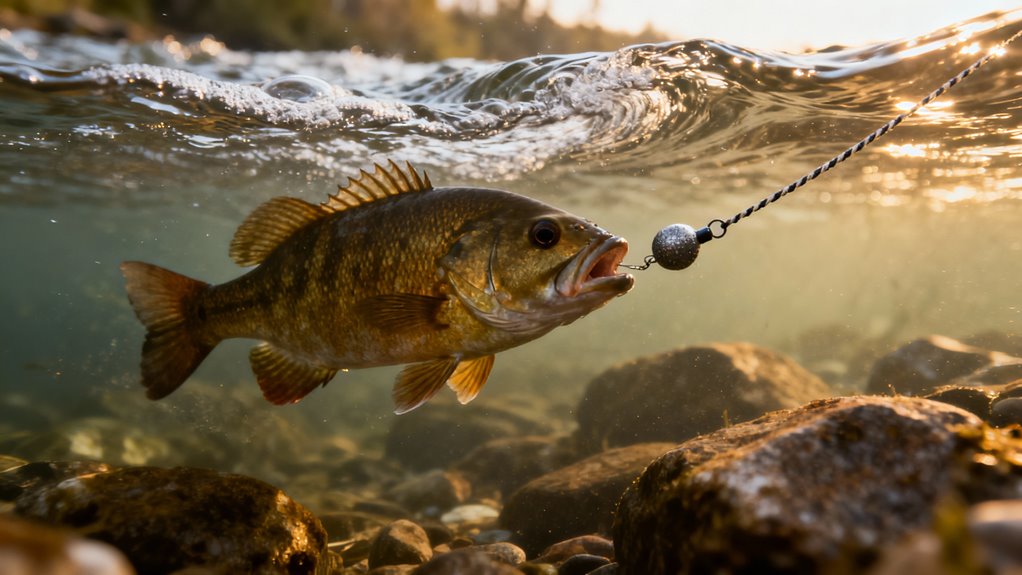
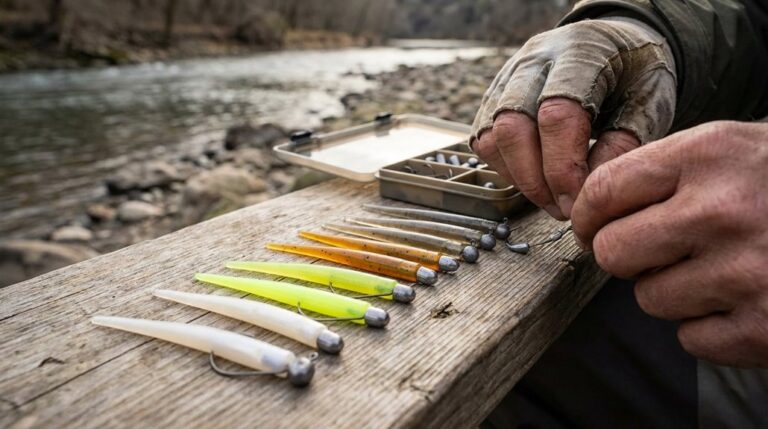
Dialed-in tackle turns a promising eddy into a guaranteed strike zone, so you need gear matched to current, depth, and fish size. Start with a 6.5–7 foot medium-heavy drop-shot rod, 12–15 pound fluorocarbon, and 1/2–1 ounce weights positioned just upstream of push lines or eddy tips. That lets you hold bottom without dragging too fast.
When you drift live bait, use the smallest split shot and a 12–16 inch leader so leeches or night crawlers move naturally in the swirl. For bigger current-break fish, throw bucktail jigs tipped with a minnow, leech, or crawler. The Daiwa BG’s smooth drag system enhances your ability to fight tough fish effectively.
| Situation | Primary Lure | Backup Rig |
|---|---|---|
| High-water edges | Spinnerbait | Crankbait |
| Defined eddies | Drop-shot | Bucktail jig |
| Exploring new water | Spinnerbait/Crankbait | Drop-shot |
Always wear a life vest and carry extra rods.
Pros and Cons
When you focus on eddies, you’re playing to a major strength: smallmouths stack up in this slack water, letting you catch multiple fish from a single current break. You also get predictable ambush spots where a well-placed upstream or cross-current cast can produce fast action. Additionally, understanding bass behavior can greatly enhance your strategy, as these fish often hide in cover and prefer certain water conditions. Still, eddy fishing has drawbacks, including heavy pressure on obvious spots, tricky boat or wading positions, and the need for precise casting angles to keep your presentation natural.
Pros
Why does fishing current breaks and eddies feel so productive so often? Because you’re tapping into spots where smallmouth rest, feed, and stack up. When current hits rocks, points, or other structure, it splits and forms a softer eddy on the downstream side. Smallmouth slide into that calm pocket, conserve energy, and wait for food to tumble by.
You gain several clear advantages:
- Predictable locations – You simply read current direction, find the point, then target the backside where the eddy spins.
- Concentrated fish – Bait gathers along the eddy edges, and a single eddy tip can give you 10–20 bass when it’s on.
- Efficient presentations – Downstream or cross‑current casts naturally sweep baits through prime ambush lanes.
Additionally, the diverse aquatic life in Deep Creek Lake enhances the chances of encountering smallmouth bass in these productive areas.
Cons
Even textbook-looking eddies come with downsides you’ve got to manage. Heavy flows can shove smallmouth into tight, awkward pockets you can’t easily reach from shore or even from a boat. Holding your position safely may demand stronger trolling motors, anchors, or wading skills, plus heavier weights or deeper‑diving baits to stay in the strike zone.
You’ll also fight inconsistency. As water levels rise or fall, the seams, backrollers, and soft pockets you mapped yesterday can shift or vanish. To handle that, you’ve got to constantly re-scout. Additionally, utilizing stealthy paddling techniques can improve your positioning and increase your chances of a successful catch while navigating these challenging waters.
Use these realities as a checklist:
- Are fish pushed into spots you can’t present to cleanly?
- Can your boat or wading setup safely hold position?
- Have flow changes already reshaped today’s eddies?
FAQ’s
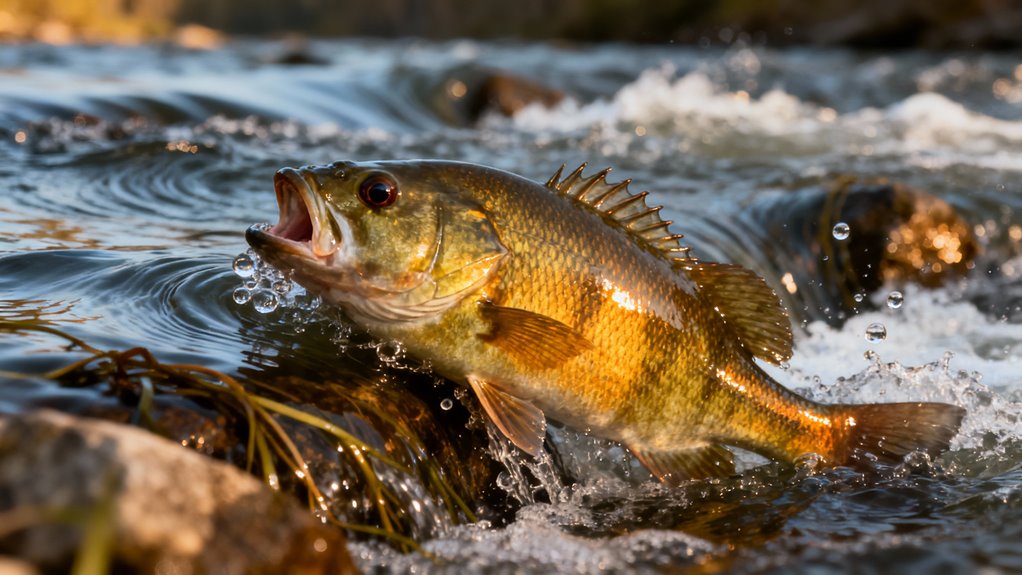
Curious how all these details about eddies, current breaks, and depth shifts actually play out on the water? Here are quick answers to common questions.
Where should you start looking? First, read the current direction, then find anything that sticks perpendicular into the flow. Focus on the back side of that point—the leeward edge—where an eddy spins and smallmouth wait.
How do conditions change spots? In high water, fish hug banks and tuck just above or behind strong breaks. In low water, they slide to weed edges, deeper current voids, and subtle structure.
How do you keep track of patterns? Label screenshots, maps, or posts with something like “Current Break Kayak Fishing FRIDAY FISHING FORUM” so you can share and refine productive eddies. Additionally, being familiar with dynamic conditions can enhance your fishing strategy.
Final Verdict
Ultimately, smallmouth in moving water aren’t random—they follow current, cover, and edges with predictable precision. Your job is to read that flow and put baits where bass can feed without burning energy. Focus on current breaks, eddies, and seams where fast water meets slow.
Target the upcurrent face of rocks and wood in moderate to high flows, plus the soft-water pockets and downstream voids behind them. Cast upstream or cross-current and let your bait travel naturally with the flow.
Work the back sides of points and the edges of eddies thoroughly. Those subtle seams often stack fish, and one key eddy tip can kick out 10–20 bass. When you line up current, cover, and angle, moving water smallmouth become highly predictable. Additionally, understanding the importance of catch-and-release practices can further enhance your fishing experience and support sustainable fishing efforts.
Frequently Asked Questions
What Is the 80 20 Rule in Bass Fishing?
The 80/20 rule in bass fishing means you’ll catch about 80% of your fish from 20% of spots. You focus on the highest‑percentage structure, refine your presentations there, and constantly adjust as conditions and hotspots change.
How to Catch Smallmouth in Fast Moving Water?
You catch smallmouth in fast water by targeting current breaks and eddies, casting upstream. Let baits drift naturally, adjust weight to current speed, and work seams with finesse rigs or compact cranks where bass sit and ambush.
What Is the 90/10 Rule for Bass Fishing?
The 90/10 rule means you’ll catch 90% of your bass from 10% of the water. You focus on prime spots, refine them with different casts and lures, and ignore dead water to stay efficient.
What Water Temperature Are Smallmouth Bass Most Active At?
They’re most active between about 50–60°F. You’ll notice river smallmouth fire up sooner, often around 50–55°F, while lake fish really turn on from roughly 55–60°F, chasing moving baits and aggressively feeding.
Final Thoughts
You’ve got everything you need to read seams, target current breaks, and work those depth changes where smallmouth live. When you match your tackle to the conditions and stay mobile, you’ll turn more “dead” water into fish-catching opportunity. Pay attention to subtle shifts in current, experiment with presentations, and commit to learning each stretch you fish. Do that, and moving water smallmouth won’t feel mysterious—they’ll feel predictable.