Long Trout Leaders: Fix Turnover Before Changing Flies starts with a simple diagnosis: watch how the leader, tippet, and fly land before tying on something new. A random pileup points to a turnover problem, while controlled curves can be exactly what your dead drift needs.
Key Takeaways
- Check the landing first: Uncontrolled bunching is different from deliberate slack spread through the leader.
- Test the whole system: Fly line, leader taper, tippet, fly weight, wind resistance, and casting stroke all affect turnover.
- Change one variable at a time: Keep the fly and cast consistent while testing leader length, tippet, or casting adjustments.
- Match length to conditions: A long leader can help with wary trout in clear water, while a shorter setup can turn over weighted flies more readily.
- Restore tippet before rebuilding everything: Replace the terminal section when fly changes or abrasion have made it too short or unsuitable.
- Keep the presentation in mind: Better turnover can land the leader too straight for a dead drift, so add intentional slack when the water calls for it.
- For related fly fishing coverage, browse The Reel Authority’s fly fishing articles.
Free Printable Field Reference & Checklist (PDF)
Save or print our one-stop reference sheet for this guide: Fly Leader Turnover Troubleshooting Flowchart and Step-Down Ratio Table. Includes the full specification comparison matrix and step-by-step field checklist.
Tell an unwanted pileup from deliberate slack
An unwanted pileup leaves the fly, tippet, and leader bunched close together near the end of the delivery. If the same cast and fly produce the same random heap several times, diagnose the setup or delivery before changing flies.
A slack-line presentation looks different. The leader lands with controlled curves, and the fly reaches the intended lane with slack distributed along the line, giving it room to drift without immediate drag.
Test over open water or another visible surface. Weed, a snag, or a fly caught in vegetation can make a clean delivery look like failed turnover.
A pileup can result from more than a casting error: a heavier fly, greater wind resistance, fine tippet, or an abrupt leader taper can all make it harder for the leader to straighten.
How the leader transfers energy to the fly
A tapered leader moves casting energy from the fly line through a thick butt section, a finer midsection, and a thin tippet. The gradual change in diameter carries energy forward; an abrupt reduction can dissipate it and create a hinge where the leader folds instead of turning over smoothly.
Think of the fly line, leader, tippet, and fly as one casting system. A long leader with fine tippet needs precise energy transfer, while a large or weighted fly needs enough leader power to carry its mass and wind resistance.
Fly Fisherman’s leader illustration shows a 9′ 4X leader made from 7′ of tapered monofilament and 2′ of level 4X tippet. The same article describes the Rule of 4: a size 12 fly matches 3X tippet, and a size 16 fly matches 4X tippet.
A knot can use up 4″ of tippet when you tie on a fly. Repeated fly changes therefore shorten the fine section and may shift the balance the leader was built to provide.
A familiar knotless leader arrives as a continuous taper, while a knotted leader uses connected sections. Either can turn over well when its diameter changes gradually and its tippet suits the fly.
Separate a setup problem from a casting problem
Keep the same fly and delivery while testing. First shorten the leader slightly or replace an overly long fine tippet section, then repeat the same cast and compare where the fly lands.
If a compact, smooth cast turns the setup over but a rushed stroke or soft stop leaves a pile, refine the cast before changing leader components. Smooth acceleration and a firm stop help the leader carry energy forward.
If several clean casts pile up with a wind-resistant or weighted fly but turn over with a small fly, suspect a mismatch between the fly and leader. The leader may be working well for one fly and lack enough power for another.
Inspect the leader for abrupt diameter changes, damaged knots, and a tippet section that has become too long or too fine. Any of these can interrupt energy transfer, so fix the fault you can identify rather than rebuilding by guesswork.
Match leader length and tippet to the fly
Leader length is a starting point, not a cure-all. A longer leader can improve presentation in clear water, but it also asks the casting system to transfer energy across more material.
The table compares common lengths with the conditions and presentations they suit. The Orvis leader-length guidance is linked in the table caption; use the turnover tradeoff to decide whether a length is helping your delivery or making it harder to control.
| Leader length | Suitable water or line conditions | Fly or presentation considerations | Turnover tradeoff |
|---|---|---|---|
| 15 foot | Spooky trout in extremely clear water in lakes and rivers. | Useful when a longer presentation helps keep the fly line farther from wary fish. | Provides reach, but demands smooth energy transfer and a well-matched fly. |
| 12 foot | Lakes fished with floating lines, and streams with flat, low, or very clear water. | A longer presentation for conditions where trout may be wary. | Offers additional length while requiring more control than a shorter leader. |
| 9 foot | Larger streams with mostly riffled water, or water where fish are less spooky. | A useful all-around reference for a tapered leader and tippet system. | Balances reach with more manageable turnover than longer options. |
| 7.5 foot | Streams from 10 to 20 feet wide, intermediate or sinking lines, and lakes or saltwater where fish are not terribly spooky. | A practical starting length for larger weighted trout streamers. | The shorter setup helps turn over flies with more weight or wind resistance. |
| 6 foot | Sinking fly lines or tiny, brushy streams where a long leader is difficult to manage. | Useful when close quarters or a sinking line calls for a compact setup. | Easier to manage and turn over, with less length for a delicate, extended presentation. |
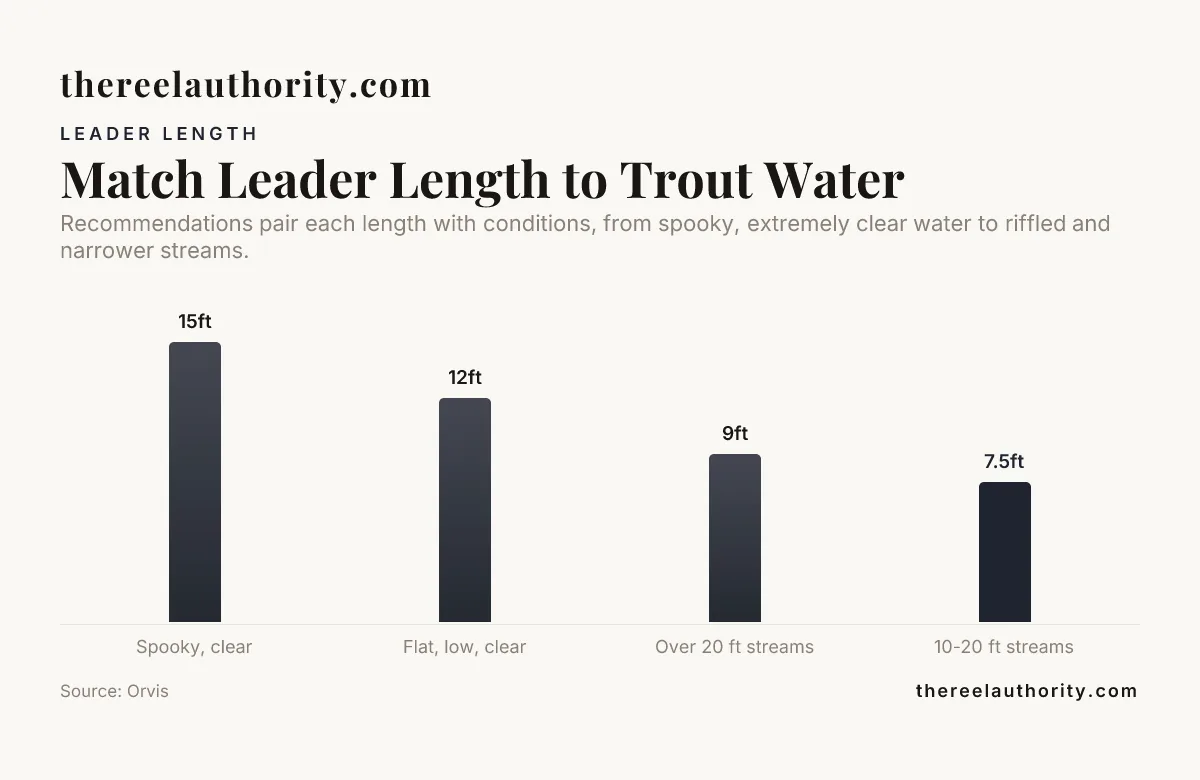
Recommendations pair each length with conditions, from spooky, extremely clear water to riffled and narrower streams.
Source: Orvis
Use the fly’s size as one input when choosing tippet, then account for weight and wind resistance, since a fly that is bulky or heavy may need more turnover power than its hook size alone suggests.
Extend or rebuild a leader without creating a hinge
When you need more reach or a finer presentation, add a measured tippet section to the existing taper rather than defaulting to a long length of fine material. Too much fine tippet can leave too little energy to turn the fly over.
Replace the tippet when repeated fly changes have shortened it, the end is abraded, or its length and diameter no longer suit the fly. Rebuild the full leader when damage or a poor taper affects more than the terminal section.
When rebuilding, step down through progressively finer sections instead of jumping from a stiff butt to a limp tippet. Keep section knots compact and secure, since bulky or damaged joins can interrupt the taper and create weak points.
| Build or adjustment | Construction | Likely effect on delivery |
|---|---|---|
| Reference build | 7 feet of tapered monofilament plus 2 feet of level 4X tippet, for a 9 foot leader. | A gradual taper transfers energy into a defined terminal section. |
| Shorter terminal tippet | Retain the existing taper and use a shorter level tippet section. | Reduces total leader length and can help turnover when a long fine section folds. |
| Longer terminal tippet | Add a measured length of level tippet to the tapered leader. | Adds reach and finer presentation, but can reduce turnover if the terminal section becomes excessive. |
After several fly changes, check the remaining tippet instead of repeatedly cutting it shorter and hoping the setup still balances. A fresh terminal section often restores the intended length and strength without replacing a sound leader butt and midsection.
Use this step by step field checklist
- Watch the landing. Note where the leader, tippet, and fly touch down, then decide whether the slack is controlled for a dead drift or randomly piled.
- Inspect the setup. Check the fly knot, tippet condition, section knots, and taper for abrasion, abrupt transitions, or an overlong tippet.
- Repeat the same cast. Use the same fly in calm conditions or with the wind at your back, and see whether a smooth delivery turns the leader over.
- Change one factor. Shorten the leader, replace an overlong tippet, or use a less wind-resistant fly, then repeat the same test before adjusting anything else.
- Keep only a useful change. Retain an adjustment when it improves delivery and still preserves the slack or drift control your presentation needs.
This sequence gives savvy anglers a dialed-in way to diagnose long trout leaders without rebuilding the whole system after one poor cast. Stick with the test long enough to see a repeatable result.
Adjust the cast while protecting the presentation
Into a headwind, use a tighter loop, lower trajectory, compact stroke, and firm stop. A wide loop gives the wind more time to push the line and leader, while extra power without control can make delivery less consistent.
For a bulky or weighted fly, accelerate smoothly and finish with a decisive stop so the leader has time to straighten. Overpowering the cast can create tailing loops and tangles instead of improving turnover.
If improved turnover makes the leader land too straight for a drag-free drift, add a deliberate reach or aerial mend. That creates useful slack on purpose rather than accepting an uncontrolled pileup from an underpowered cast.
Should your leader be heavier than the main line? Not at the fly end: the tippet should be finer than the leader butt, with a gradual transition between them. Match the butt to the fly line’s energy and the terminal tippet to the fly and presentation.

Frequently Asked Questions
Can I attach a new leader to the fly line with a loop-to-loop connection?
Yes, a loop-to-loop connection is a practical way to change leaders without cutting the fly line connection each time. Keep the loops compact and seat them fully so the join passes cleanly through the guides.
How can I straighten a coiled leader before fishing?
Pull the leader gently between your fingers or through a soft cloth, working from the butt toward the tippet to release storage coils. Avoid sharp pulls and direct heat, which can weaken or deform the material.
How do I keep knots between leader sections from catching in the guides?
Use compact, properly seated knots and trim tag ends close without cutting into the knot itself. When a connection still catches during frequent shooting, keep that join outside the guides during the cast.
Why does the fly line land ahead of the fly even when the leader turns over?
The leader can straighten in the air while the fly loses forward speed, leaving the heavier fly to touch down behind the line. A lower casting trajectory and a slightly softer delivery can reduce that separation when the presentation allows it.
Can I use a tippet ring when extending a long trout leader?
A small tippet ring gives you a fixed junction for replacing the terminal section without repeatedly shortening the tapered leader. Keep the added connection neat and match the new tippet diameter to the fly and the existing taper.
See also: The Angler’s Edge: Knowledge You Can Trust, Best Baitcasting Combo, Garmin Striker Vivid 4cv Review.
Conclusion
Long Trout Leaders: Fix Turnover Before Changing Flies means diagnosing the landing, then testing the leader, tippet, fly, wind, and cast one at a time. Preserve a gradual taper, replace worn or shortened tippet when needed, and make casting adjustments that turn the fly over without sacrificing the slack your dead drift requires.
When you can tell controlled slack from a failed delivery, you can correct the cause instead of swapping flies at random. That is the crucial move toward a more reliable, well-balanced trout setup.
Download the Companion Printable Reference Sheet (PDF)
Save or print our one-stop reference sheet for this guide: Fly Leader Turnover Troubleshooting Flowchart and Step-Down Ratio Table. Includes the full specification comparison matrix and step-by-step field checklist.